 English
 Arabic

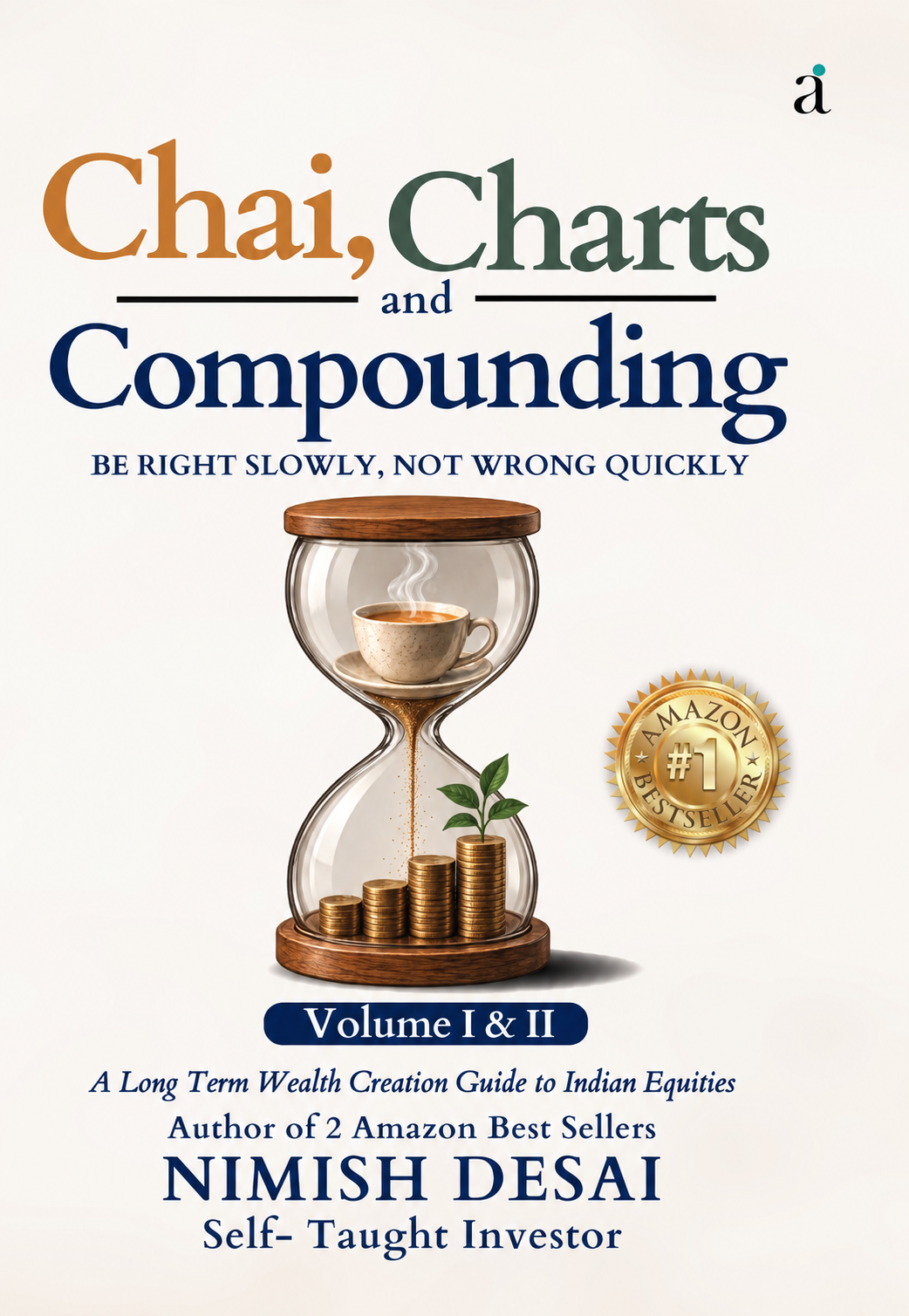
Chai, Charts and Compounding: Volume I & II
Original price was: ₹1,500.00.₹1,200.00Current price is: ₹1,200.00.
Most investors today do not suffer from a shortage of information. We have annual reports, quarterly results, concalls, screeners, charts, social media opinions and twenty different ratios available before the chai gets cold. The real problem is deciding what deserves our attention, what can be ignored, and how all that information should finally change what we do with our money. Chai, Charts & Compounding – Be Right Slowly, Not Wrong Quickly is my attempt to make that process practical. This is not a book of stock tips, quick multibagger formulas or predictions about where the NIFTY will be next month. It is a long-term investing book about how we can study an Indian listed business, judge the evidence, value the stock, decide whether the expected return is attractive, and only then decide what role – if any – it deserves in our portfolio. The entire book revolves around three questions that sound simple but are very easy to mix up: Is this a good company? Is this an attractive stock at the current price? What should our portfolio do? A wonderful business can still be a poor purchase at an unreasonable price. A falling share price does not automatically mean that the business thesis is broken. And a strong chart can help us think about timing, but it cannot make weak fundamentals good. Keeping these distinctions clear is at the heart of disciplined investing. I did not want this to become a finance textbook that explains everything beautifully and then leaves the reader wondering what to do on Monday morning. Reader Workbooks throughout the book and the analytical toolbox in Appendix B are designed to make us use the ideas on real companies. The purpose is not to memorise terminology. It is to build a repeatable research habit – one that helps us separate fact from narrative, conviction from attachment, patience from denial, and genuine compounding from mere market re-rating. This book is meant for the serious self-directed investor – whether you are still learning how to read an annual report or have been investing for years and want a more organised process. You do not need to become an accountant, a chartist or a professional fund manager. You do need to remain curious, verify what you can, accept what you do not yet know and be willing to change your view when the evidence changes. If you are looking for a list of stocks to buy tomorrow, this is probably not the book for you. If you want to learn how to ask better questions before committing capital – and how to keep asking the right questions after you have invested – pull up a chair. The chai is ready. Let us begin. What the reader will find inside Company Quality -> Stock Attractiveness -> Portfolio Action Real Indian listed-company situations and evidence-led case studies Financial statements, governance, capex, debt, valuation and expected return Reverse Expectations and Red-Team stress testing Charts for timing, not thesis Portfolio construction, tranching, monitoring and sell discipline Reader Workbooks plus a reusable analytical toolbox in Appendix B A complete start-to-finish Full Underwrite showing how the process comes together About the Author Er. Nimish M Desai – SELF-TAUGHT INVESTOR – is a Civil Engineer, entrepreneur, author and self-taught investor whose professional life has been shaped by systems, discipline and a persistent instinct to ask: why are we doing it this way? He entered the Indian equity market in 1994 with his first investment in HDFC Ltd. What followed was not a straight path to investing wisdom, but years of mistakes, learning and gradual refinement of a research-led approach to long-term wealth creation. Today, he oversees five family investment portfolios, each built around a defined purpose, allocation discipline and periodic review process. He is the author of three earlier books, two of which became Amazon Bestsellers. In Chai, Charts & Compounding, he brings the same practitioner-first thinking to investing – questioning conventional wisdom, stripping away noise and focusing on what the evidence actually tells us.
Description
Most investors today do not suffer from a shortage of information. We have annual reports, quarterly results, concalls, screeners, charts, social media opinions and twenty different ratios available before the chai gets cold. The real problem is deciding what deserves our attention, what can be ignored, and how all that information should finally change what we do with our money. Chai, Charts & Compounding – Be Right Slowly, Not Wrong Quickly is my attempt to make that process practical. This is not a book of stock tips, quick multibagger formulas or predictions about where the NIFTY will be next month. It is a long-term investing book about how we can study an Indian listed business, judge the evidence, value the stock, decide whether the expected return is attractive, and only then decide what role – if any – it deserves in our portfolio. The entire book revolves around three questions that sound simple but are very easy to mix up: Is this a good company? Is this an attractive stock at the current price? What should our portfolio do? A wonderful business can still be a poor purchase at an unreasonable price. A falling share price does not automatically mean that the business thesis is broken. And a strong chart can help us think about timing, but it cannot make weak fundamentals good. Keeping these distinctions clear is at the heart of disciplined investing. I did not want this to become a finance textbook that explains everything beautifully and then leaves the reader wondering what to do on Monday morning. Reader Workbooks throughout the book and the analytical toolbox in Appendix B are designed to make us use the ideas on real companies. The purpose is not to memorise terminology. It is to build a repeatable research habit – one that helps us separate fact from narrative, conviction from attachment, patience from denial, and genuine compounding from mere market re-rating. This book is meant for the serious self-directed investor – whether you are still learning how to read an annual report or have been investing for years and want a more organised process. You do not need to become an accountant, a chartist or a professional fund manager. You do need to remain curious, verify what you can, accept what you do not yet know and be willing to change your view when the evidence changes. If you are looking for a list of stocks to buy tomorrow, this is probably not the book for you. If you want to learn how to ask better questions before committing capital – and how to keep asking the right questions after you have invested – pull up a chair. The chai is ready. Let us begin. What the reader will find inside Company Quality -> Stock Attractiveness -> Portfolio Action Real Indian listed-company situations and evidence-led case studies Financial statements, governance, capex, debt, valuation and expected return Reverse Expectations and Red-Team stress testing Charts for timing, not thesis Portfolio construction, tranching, monitoring and sell discipline Reader Workbooks plus a reusable analytical toolbox in Appendix B A complete start-to-finish Full Underwrite showing how the process comes together About the Author Er. Nimish M Desai – SELF-TAUGHT INVESTOR – is a Civil Engineer, entrepreneur, author and self-taught investor whose professional life has been shaped by systems, discipline and a persistent instinct to ask: why are we doing it this way? He entered the Indian equity market in 1994 with his first investment in HDFC Ltd. What followed was not a straight path to investing wisdom, but years of mistakes, learning and gradual refinement of a research-led approach to long-term wealth creation. Today, he oversees five family investment portfolios, each built around a defined purpose, allocation discipline and periodic review process. He is the author of three earlier books, two of which became Amazon Bestsellers. In Chai, Charts & Compounding, he brings the same practitioner-first thinking to investing – questioning conventional wisdom, stripping away noise and focusing on what the evidence actually tells us.
You must be logged in to post a review.





Reviews
There are no reviews yet.